Posts Tagged ‘knitting’

Knitting, Sounds, & Good Weekends continued…

Saturday, August 28th, 2010

I posted a few months ago about the importance of Good Weekends and so far, that is what today and tomorrow are shaping up to be. Incidentally, the grunting pigs sound which I posted from Mudchute Farm on that post is now up on the UK SoundMap (my new favourite thing!) and The London Sound Survey. I have also been uploading some sounds of Rachael spinning and ball-winding to the UK SoundMap, as I think knitting sounds must be represented! And anyone who cares to browse the map will also see that my favourite road – the A4074 – is also sonically documented by me, in sounds that range from a hoverfly buzzing in Caversham Heath, to the revving of biker engines outside the HCafe. It is very easy to upload via Audioboo, and I’ve been really enjoying listening to other people’s sounds – especially the sounds from remote places, such as the lovely recordings of time and tide bells uploaded by Vergette. If you don’t know about the UK SoundMap, Richard Ranft gave a great interview about it on Radio 4′s TODAY programme, and there is a bit more information here on the Sound:Site blog, as the British Library will be speaking at our festival about the map.

On a very different festival note, the lovely Mark is off at Reading with his boys this weekend. I confess that I do not like the crowds or – bah humbug – the Music at this event. I would brave snow, rain, hailstorms and the worst portaloos in the world for a knitting festival or some amazing sound-related celebration, but loud rock music is something I am mostly keen to avoid. I love small festivals – like the Shillingford and Warborough Festival, or the Oxford Folk Festival… but the big ones really freak me out and belong on a list of things in my head which is titled ‘Things which are meant to be SUPERFUN but are really ACTUALLYQUITESTRESSFUL.’

Although I accompanied Mark to Reading Festival in 2008, I confess I didn’t have a great time there beyond my happy discovery of Santogold and her amazing music. In fact the last ‘big’ festival I really enjoyed attending in Reading was WOMAD in 2006. I couldn’t walk very easily back then, so I hired a scooter for the day and enjoyed speeding around the site with my felt-covered walking stick and indulging in some reckless drunk-scooter-driving (which Mark captured on camera, for posterity.) From memory, it was a happy day of pies, spiced cider, laughter, and painkillers. We cruised the stalls, enjoyed looking at all the shiny-shiny, listened to a few bands, and tried on wigs. The scooter was genius, as people gave me a very wide berth – something that you don’t get when you are walking about, even when you have a walking-stick – and it meant I enjoyed the day relatively pain-free. Although my arthritis doesn’t really affect me in that way anymore, I find that what I love doing in my life remains forever changed by the experience of having been disabled… and maybe this is why the noise and the crowds of Reading Festival have me mooching about indoors for a quiet weekend, this year.

I do, however, enjoy the distant wash of bass and excitement that drifts over here from the site – which is several miles away – in the evenings, when the wind is right. It is a distinctive and regional aspect of the soundscape, and an annual sound event, and this evening I hope to record this sound and place it on the UK SoundMap. (Did I tell you already how this is my new favourite thing?)

Other than making this recording, I am hoping to catch up with friends on the telephone, (really, is there anything better than a good long chat with a girlfriend, plus a bucket of tea and a mindless knitting project?) cast on for the second sock in the pair that I making for Mark, (Rav-link) and reflect on all the things I learned at Knit Camp.

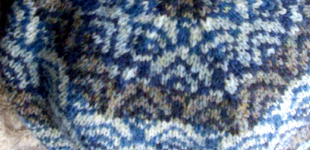
Here is the inside of Mark’s 1st sock, in all it’s woven-strandy glory. Although I agree with what Kate says about leaving long strands in her excellent post on the subject of stranded knitting, when it comes to the fabric of a sock, I find that any strands over 5 sts in length do get tangled in one’s toes, however sticky and woollen your yarn! For this reason, my other colourwork socks have used very short and simple patterns – just one or two stitches before each colour-change – so as to create a warm, snug, dense fabric with no entangling loops lying about.

My first stranded-colour socks

Look at the little strands!

However, because in the case of Mark’s socks I wanted to depict objects which would involve large swathes of one colour or the other, I decided to travel the yarn across the back and weave it in as I went. This creates rather a tweedy look in some areas – a little bit like the effect that the Armenian Knitting Technique creates Elsa Schiaparelli’s Bow Sweater.

The socks depict scenes from along Mark’s Walk 2012 walking route; the route he has been plotting over the past few months, and blogging about, here. Scenes on Sock #1 include: Seagulls, (Weymouth) Durdle Door, The Square and Compass Pub at Worth Matravers, (a truly amazing refuge) and a New Forest Pony.

The real Durdle Door

A bad photo of my dodgy, knitted version!

A real New Forest Pony

My knitted interpretation (which Mark has started calling ‘A Camel.’)

One of the things I learned at Knit Camp involved my depiction of a horse, as this was the subject of energetic debate in the car on the way home from Stirling. Ellen correctly pointed out that my first attempt at charting a design appeared rather wolf-like, and furnished me with a helpful drawing, which led to much travel-sickness inducing scribbling on my part, and the final horse-design, which I hope you will agree is more equine than the first attempt.

This was one of many instances where just informally hanging out with knitters meant that I learned loads and moved something on far more than I could have done on my own. The actual organised *classes* were also good, and I have come away with much information on how to make the perfect Aran, and about how different types of fleece and yarn can be used for creating different things. Consider for a moment the difference between the knitted fabric created by 100% Manx Yarn;

…and a fabric knitted from Castlemilk Moorit yarn, which is blended with a little silk and Alpaca, to soften it:

I hope you can see that in the bottom photo, the Castlemilk Moorit fleece gives greater definition to each of its stitches than the Manx wool? The Manx fleece makes a wonderfully dense, gingery, rich, warm fabric of joy, which makes me feel immediately that the Winter can be kept at bay. I left Knit Camp and Deb Robson’s class on knitting with rarebreed wools lusting for a simple sweater made in this wholesome stuff. However, the Castlemilk Moorit yarn is a little crisper and the mixed-fleece gives a varied, tweedy effect to the yarn, which I think would be perfect for creating an amazing Aran. I ordered 2 balls of Castlemilk Moorit from Blacker Designs, in order to start swatching for an Aran cardigan based on the theme of Sound. Like Liz, I really enjoyed steeking in Jared Flood’s Class at Knit Camp, and I left Flood’s class with all the knowledge I need to confidently swatch for, calculate yardage for, and begin, a big Aran project. For me the golden discovery re: my future Aran was the Castlemilk Moorit Yarn with its special, stitch-popping tweediness, coupled with some empowering maths regarding how to design such a masterpiece.

For the sonic-celebration-Aran, I want to use Popcorn stitch, the superimposed double wave cable, (as it reminds me of soundwaves) maybe the banjo-cable, and one I’ve seen in one of my knitting books, which reminds me of a long string of ears, because of the way the cable widens and narrows up and down its length.

I found the discussion of rare breed sheep at Knit Camp to be very interesting, especially the information about the St Kilda archipelego, and the now very rare Boreray and Soay sheep. There are less than 300 breeding ewes left of the Boreray sheep breed, and they are listed as being critically endangered by the RBST. I have written before about my obsession with the extreme North of the UK and the Hebridean islands that lie just off it but UK Knit Camp 2010 made me want – even more than before – to learn more about these places where our rarest and most endangered sheep breeds come from, and the knitting traditions therein. Deb Robson is right when she says that we have the power – as knitters – to keep the rare breeds alive, and so I spent the majority of my yarn allowance at UK Knit Camp on wool from rare breed sheep. The North Ronaldsay sheep is on the endangered list of sheep breeds; I couldn’t buy any Boreray yarn, as there was none for sale, but I did buy some natural-coloured North Ronaldsay and some hand-dyed North Ronaldsay – both from Liz Lovick’s Northern Lace stand.

Liz gave me a pattern for the ‘Cat’s Paw Scarf,’ which I might make from that second skein of dyed yarn, because I really liked Lovick’s notes in the pattern about the history of the pattern. It is apparently a traditional Shetland pattern, a lacy thing with a short repeat that is easy to remember, which can easily be picked up and worked on in between other jobs, and which is thus worked in order to be sold at the end.

I also purchased this fine hand-spun/plant-dyed yarn from Elizabeth Johnson, and I am reminded by the colour of the sea and also of the amazing recording in the British Library Archives from Harris and Lewis. This can’t be accessed without an Athens log-in unfortunately, but it is one of my favourite regional recordings of all time, especially for the section where a sheep is being sheared using old clippers, and the shearer is talking about the condition of the Rams that year.

Yarn – like sound – is for me a material that is deeply linked to ideas about places and regions. As I scour the Internet for knowledge about different sheep-breeds, I am also searching for sounds that come from the regions where those breeds are from. Somehow it helps me to plot and plan what I will knit, to picture in greater detail the places I want to visit, and to envisage terrains, ways of living, and flora/fauna that surround different knitting and sheep-keeping traditions.

Here are some sounds I have found around, which remind me either of places I’ve been to, or places I want to go to, and all the knitting projects in between.

I hope you too are enjoying some good sounds and some good yarns, this weekend.

Waves at Chesil Beach on Joe Steven’s site: – reminds me of Mark and of Weymouth, and of the Portland sheep breed

St Kilda Cultural Traditions: – webpage has embedded sound (quite high, quite loud, turn your speakers down!) reminds me of Boreray and Soay Sheep

HATS!

Wednesday, April 28th, 2010

This is another illicit, in-between-assessing-and-assignment-writing post, stolen in a twenty minute gap along with lunch – which is a tasty little egg sandwich. In the spirit of my current mode of operation, today’s subject is the pleasureful nature of the mindless, fast, gratifyingly instantaneous knitting project.

I’m talking about the sort of knitting project that can be made up in pauses and bursts, in 20 minutes on the train here and 15 minutes waiting for dinner to cook there. I mean the sort of project which can be put down halfway through a row without dire consequences, and which ends up being wearable, pleasing, and joyous at the end of the knitting process; a project which has enough stitch-pattern interest to be fun but not the sort of complexity that might result in the frustration of ripping out stitches. And ultimately, the sort of project for which you probably already have yarn lying around, maybe in the form of ends or odd bits, perhaps an extra ball of DK left over from a sweater…

A project sort of like Dawn Leeseman’s Zigzag Beanie pattern, from Interweave Knits, Fall 2008.

I churned 2 of these bad boys out in April, both from old ends of stash.

The one on the left is knit from tiny balls left over from Layter, knit with a single strand of kidsilk haze. I do like this strategy when working with similar but not identical shades of yarn; knitting a single strand of kidsilk haze along with everything else gives everything a hue-in-common, akin to a wash in painting, so that things harmonise, colour-wise. Plus, I love the fuzzy, ethereal halo that kidsilk haze imparts to an otherwise plain dk yarn.

I have adorned this hat with a beautiful birdie brooch from Kate, and I wear it when in the shade or walking home late in the evening when there is still a bit of a chill in the air.

The hat on the right is for my Gran, who tried to teach me to knit when I was very small and instilled in me a very great appreciation for all things handmade.This is knit from something very lustrous and pretty which I only had a little ball of (no idea what the fibre was!) and some alpaca. I love how the alpaca has a sort of bluish quality, whereas the other camel colour is much more yellow… I like the little stripes and the way the colours work together.

This morning, this hat went on its merry way to my Granny in the post, along with the hat I made for my Grandad. I don’t worry about sending them woolly hats at this time of year, since they live by the sea and there is often a cold breeze and I think a nice hat will take the egde off the chill when they are walking along the seafront.

I hope they like them. It is very nice to make something for them; over the years they have made me many, many lovely things… a wooden rocking chair (made by Grandad) with a patchwork cushion, (made by Granny) when I was very small, (child-sized so no longer in use by me!) knitted fingerless mittens when I lived in Ireland, (knit by Granny) a dollshouse when I was a girl, (made by Grandad) dollshouse furniture, (a textiles/wood G & G collaboration) beautiful pictures, (embroidered dragons and chickens mostly) and many, many other things. My Granded used to supervise our lego-building sessions and teach us how to arrange our bricks for maximum structural stability, and my Granny used to – and still does – show me her creative projects; mostly watercolours and textile projects. She always has a project on the go and little bags stuffed with embroidery floss, beads and scraps of lovely fabric squirreled away in corners all round her spotless home. I have inherited the squirreling but sadly not the spotlessness, from her. And those early lego sessions with my Grandad have, I’m sure, played a crucial role in developing my DIY abilities!

Here we are, hanging out together on my birthday last year. Please overlook my beer face; it was my party…

And here are the hats. Zigzag beanie from Interweave knits, Fall 2008, knit in very soft oddments in camel coloured mystery yarn and alpaca for my Granny – Margaret – and for my Grandad – Wilfred – a mash-up of Wazz’s Woollen Winter Walking Outfit #1 by Kate, and Turn a Square by Jared Flood.

Hurrah for the quickly-knit hats and for warm heads and pretty colours and hurrah for my amazing Grandparents and all they taught me about making.

The LISTEN hat™

Wednesday, March 31st, 2010

I had another look through the Sound Art To-Do-List and was gratified to see that I am (mostly) on track with various sound-related projects and jobs at the moment. The recent counting prevails with WW points, £-watch and some happy knitting maths. It turns out that a 15-stitch-wide S is not an easy thing to chart. Several attempts involving sellotaping layers of graph paper over each other on the window (lofi-lightbox) resulted in the following solution, which I think will do nicely for my purposes.

In the course for working out the charts for the letters LISTEN for my LISTEN hat™, I came across the beautiful abecedarium project by Unionpurl. I love all the knitting history that she includes on posts concerning individual letters – for example all the words and images about Turkish knitting in her T is for Turkey post, or all the lovely Red information in R is for Red letters. I was so distracted by the beauty and intricacy of Unionpurls’ tasty letters that I could easily have become distracted into researching the history for each individual letter on my LISTEN hat™, but I intend to press on with it rapidly. I need to make it literally FLY OFF MY NEEDLES in time for all the occasions on which I will need it this Spring/Summer to assist in all my sonic doings.

I have been on a grey/brown/neutral kick for a long time now because of a combination of elements; firstly, the walnut dye experiment proved to be a delicious journey in browns, and I became really obsessed with dyeing things with black walnuts.* Secondly – and relatedly** – I have fallen in love (hard) with the natural colours of sheep fleeces. And thirdly, the colour tones of the sky and the trees and everything I like to look at have been overwhelmingly white, mushroomy, grey, silver, cream, ivory, slate, chocolate, earthen, ashy, beige, peaty, tea-coloured, dried-up-leaf brown, faded ochre, dulled rust or ebony over recent months. And though I have found this long cold Winter hard, I have embraced this palette and am happy to now own one outfit in which everything is the same shade of gorgeous Wintry DINGE.

However Spring is coming and the LISTEN hat™ will be knit in bright, decadent shades to celebrate the richness of the entire listening experience and the impending sunshine.

These are the colours I intend to employ in the LISTEN hat™ which will come with the following features:

1. earflaps for exposing the naked ears to the soundwaves present in any environment or shielding and protecting the ears in situations where the listener deems such protection necessary
2. a pocket for earplugs for those times when the listener wishes to internally browse sonic memories, or hear thoughts without interference
3. an angora lining*** which will act as a pop-shield for binaural microphones when the listener wishes to wear them and pick up sounds other than THE WIND BLOWING ACROSS THE MICROPHONE HEADS****
4. an emphatic linguistic reminder to the listener, to focus attention on that specific task whenever wearing said hat

The desire for the LISTEN hat™ has arisen both from my deepening obsession with listening to everyday sounds, and from my own observations re: how much I talk. To tell the truth, sometimes I feel like ‘The Chatty Hunter’ from my favourite Orange commercial, featuring the late Patrick Swayze. One of the features of recording my conversations regularly, is that I am now hyper-aware of my regrettablee tendency to interrupt other people and to be effusively noisy in exactly the crass way that Swayze is against in his characterisation of ‘The Silent Hunter.’ So I am interested in finding a way to remind myself of the power of LISTENING, and have decided to make the idea of my metaphorical ‘listening’ hat, into a knitted reality. Unlike Swayze’s potential protagonist, I have no intentions of become a silent assassin. However I do want to get better at quietly hunting sounds and I think the hat will be a powerful tactile/aural/visual reminder of this intention.

One of the things I am super excited about is the role that I hope the hat will play in my ongoing research for the A4074 podcast/walking/radio project, which I intend to exhibit/broadcast as my final major PhD work this Autumn. This project is all about connecting to a landscape on foot that I have experienced hundreds – maybe thousands – of times in a car, but only a few times at the intimate level of walking. Listening is an important way of connecting with a place, as it gives wonderful spatial information about the lay of the land, the size of clearings in the forest, the height of trees, the density of a hedge, and so on. I also find that listening is strangely intimate as soundwaves physically touch my ears in a way that I can physically feel. I know that technically lightwaves touch my eye, but I do not feel this contact in the same bodily way that I feel sounds.

However there is also for me a tactile relationship between place and the body which extends from listening to wool. Knitting can be used to transcribe aspects of a landscape into clothes – which can then be worn in that landscape – and this for me is like an extension of that physical listening experience; a way of bringing the body and the imagination together in order to inhabit or experience a profound sense of place.

Alice Starmore’s yarns and their colour stories for me reflect the tactile noticing or observation that knitting can bring to one’s vision of a landscape. When I read the colour stories, I feel like I am experiencing a way of seeing the world with the eye’s hands.***** Kate already wrote very beautifully about the connections she found between Starmore’s colour stories and the process of knitting with those yarns and then wearing her resultant hat in the very places that informed the colourways, but I have a slightly different experience of the Starmore yarns because I am not familiar so much with her Hebridean landscapes. However I am finding that as I knit with them and walk along the A4074, I am dreaming up new colourways, reflective of the Oxfordshire flora and fauna, shades like:

Rustling corn – a blend of silvery, pearly whites mixed with creams and yellows and faded greens and brown, shadowy accents.

Acorn – a radiant, golden brown blended from ochre, golden yellow, peanut-butter brown and a blush (just the tiniest hint) of lime green.

Weathervane – a barely black mix of slate grey and blueish black, shot through with little accents of rust red and a patina of frosty white.

…and so on.

I do not have photos for the Red Kite that dominates the skies along the A4074 or the pheasants that I find so regionally distinctive (I really never saw so many until I moved to Oxford) or the bright yellow fields of rape which unfold like a flag for two weeks around May as you crest the hill leading down towards Ipsden, or the blue flowers which line that same stretch of the A4074 at the height of Summer. But I should like to find colourways for all of those things, and for the beech trees which create such a grand stillness in the forests around Cane End, and for the hedgerows and their bounty of sloes and hawthorn in the Autumn. But in the meantime, I shall play with Starmore’s yarns and make my listening hat and wear it while I explore all the treasures in those places that I have not yet uncovered.

*in fact I still have the dyepot in my shower in case I need to re-dye my sweater or brighten up a dull skein.
**I am intrigued by the different qualities in brown-ness between walnut-dyed white yarn and inherently brown yarn. Even when the shade of brown is ostensibly the same i.e. it would look the same if it was painted on a shade card, the actual yarn is totally different because of the way the colour pervades and saturates.
***an idea I first encountered via Kate’s amazing knitted designs, notably her peerie sampler hat and her headband.
****a sound which is scrambled far beyond its normal sounds by translation into digital formats.
*****if you can talk about ‘the mind’s eye’ surely you can talk about ‘the eye’s hands?’

FO: Wazz’s Woollen Winter Walking Outfit and Turn a Square pattern mashup

Monday, March 29th, 2010

Two of my favourite patterns; Wazz’s Woollen Winter Walking Outfit #1 and Jared Flood’s Turn a Square pattern, mashed up into one happy hat of joy, to be given as a gift to my Grandad – who I hope does not know about my blog. If you *do* read this, Grand Pappy Wilf, Happy Birthday! This will go in the post to you as soon as I sort out a brim and weave in the ends.

Keen-eyed spotters will notice the slightly unpleasing maths that I have applied here, for there are 5 pattern repeats in the lovely colourwork and 4 decrease points for the hat shaping… however I have forgiven myself for this asymmetry, since it was very nice to do something spontaneous and organic and to allow this lovely piece of knitting to flow from the needles without getting too hung up on the numbers – which have been something of an obsession recently.

It is proving very difficult to show you in these photographs just how well the Alice Starmore yarns work together. In the spirit of thrifting, I decided to use the Starmore yarns already in my stash rather than acquiring the exact shades detailed in Kate’s original pattern. There are pros and cons to this approach; I like to see the different effects caused by working up the pattern in different colours, and it is good I think to contribute another variation in shades and colours to the Ravelry projects gallery. However on the other hand, the bits of the design that I was able to execute in the shades specified by Kate were so pleasing that I would like to at some stage repeat my wwwwo#1 pattern with the original colours.

For instance, working the middle sections in pebble beach (an intriguing golden/orange/blueish/pinkish grey) and solan goose (a creamy/blue/golden/white) I was struck by how the heathery qualities of these shades helped them to work together. I love these two colours side by side and the way they blend into one another via their shared tones. The blending of one shade into another is helped by a kind of mutual or shared quality, so that the colours don’t jump suddenly from one to another, but rather move through subtle grades through from one to another. You’ll see that I decided to work the middle sections of the star motif in bogbean (a sort of bright, emerald green) to make it pop and lighten in the middle, as well as in the background. I think there is more affinity between the pinking oranges of the pebble beach and some of the subtle undertones in the machair colourway that Kate used, however I like the jumping effect of the blue that I used and the way the oranges in the pebble beach colourway contrast directly against it. The whole experience taught me a lot about the lovely Starmore Yarns, and the way the colours all work together, and it adds to something I was thinking about during the last meeting at the Oxford Guild of Weavers, Dyers and Spinners concerning natural dyes and the behaviour of different kinds of pigments and dyestuffs.

A speaker came to talk to us about natural dyes, and he talked about how many plants which produce dyes share certain compounds like tannin, which mean that they reflect colours with an affinity for one another. He reasoned that when there are perhaps a hundred colouring components within a dye plant, one or two of them must be the same as in other plant dyes; therefore there are parts of the colour spectrum which these colours share and because they share these bits of the spectrum, they can sit beside one another harmoniously. On the other hand, artificial dyes and pigments are made to be far more pure. This means that they tend to reflect ONLY the colour they were intended to reflect, and that matching them with other pure colours from completely different areas of the spectrum requires a very careful eye. I think that using heathery blends is a way of mimicking this multi-coloured light-reflecting quality that natural dyes have; this thing we find in nature whereby light and colours are reflected in many different shades which all go together, because they all share parts of the spectrum. You know how the sea sometimes looks blue and sometimes grey and sometimes green, yet it is always essentially sea-coloured? Well to me this is very much like how – with plant dyes I’ve used, anyway, you can get loads of greens and yellows and browns and blues and reds which all share a certain kind of plant-colour. And this is the genius of the Starmore Yarns; they reflect Nature’s multi-chromatic scales of colour, and the way that colours change according to weather, seasons, light and whatever is beside the thing you are looking at, so that sometimes tree bark looks silver, and sometimes it looks brown.

I loved doing this colourwork so much that I already have plans for a second hat, a listening hat, worked for my own head and including a pocket for earplugs for when I want to hear myself think and fuzzy, built in angora windshield properties for those moments when I am walking with binaural microphones in my ears and want to catch the sounds without catching the wind.

Angora lining; the natural windshield for ear-worn microphones!

Pattern mashup Ravelled here.

Generosity and Numbers

Thursday, March 25th, 2010

This weeks’ numbers are all about generosity. Not only have I been generous to myself with my WW points (woops!) but I have also been given many things this week that have made me think about gifts and the role that kindness plays in material sustenance.

For instance Liz turned up at Sticks’n'String this week with a food parcel for me! I was very touched by this gesture but also concerned that perhaps I had been whingeing a little bit *too* much about my circumstances in last weeks’ numerical roundup. I must stress that I am viewing being broke and bigger than I want to be as amazing opportunities to get better at budgeting and eating sensibly as I feel my skills are very wanting in both of these regards. I welcome the creative challenge of counting more carefully and trying to live with/on less, and I am hopeful that it may improve my mathematical powers to apply a numerical understanding to food and money. I am blogging about my explorations in this area because I am certain I cannot be the only person who struggles with numbers, and I have been enjoying other blog projects which look at different economics – like the economics of craft at PYF’s woollen mill last week, or Cargo Cult Craft’s investigation of ‘wartime ration fare’ allegedly on sale in the Imperial War Museum or Colleen’s posts on thrifty food. I remember enjoying the practicality and thoughtfulness with which Katie noted the price of producing her Framed Baby Blanket when she blogged about that, and being struck a few years ago by the rich complexity and difficulty in Ani Di Franco’s open letter to Ms. Magazine concerning her monetary sense vs her view of herself as an Artist. In summary, I think our personal economics are fascinating, culturally loaded, difficult territories absolutely worth exploring from all angles, and I do not mind the squeeze I am in at the moment because 1. I know it’s only temporary and 2. it is proving to be a valuable learning experience.

But for all that, it has been very nice indeed to munch my way through measured portions of dried fruit, deliciously sweet cherry tomatoes, M&S roasted vegetable couscous, topical apples and all the other tasty noms that were contained in Liz’s generous food parcel and I very much appreciated it, so thank you. I have also been massively helped out by Mark, who – in exchange for my lending him my car while he had his serviced – *filled* my tank with costly petrol and has thus ensured that should I need to get anywhere at all this week, I can. Both of these things were quite humbling experiences for me and in terms of counting, reminded me how generous people are and of the part that gifts, exchange and kindness play in my domestic economics.

Gifts have also been involved in my recently completed unspun icelandic shawl, the yarn having been given to me by Kate in response to my extreme love for all things super-sheepy. The pattern was also free to me, being the Winter 2009 Knitty’s Bitterroot, and I was given a lot of helpful (free) advice from my fellow knitters in knitting it, notably Judith’s amazing yardage calculator spreadsheet (which truly is a feat of mathematical talents!) and advice from Ravellers ThereseS and Manisha, who shared their insights into knitting unspun Icelandic yarn without breaking it.

Unspun Icelandic Shawl.

This all reminds me that the craft world is full of informal exchange and amazing generosity; for instance check out the beautiful skirt that Zoe made from cleared-out-bits of other peoples’ stash this month or consider the exchange values at work in a destash/yarn-swap. I have been thinking to myself this week that the time that members of the Guild of Oxford Weavers, Dyers & Spinners are willing to give to novices learning to spin lumpen, questioning yarns, is amazingly generous…

Another ball of learning wool.

I therefore present Wednesday and Thursday’s numbers and knitting with the caveat that they are only a partial representation of my personal economy, and that there are many things which sustain me that cannot be counted in numerical terms. In short, I am lucky and people are very generous to me.

Wednesday’s Numbers:

WW points consumed: 28
£s spent: £2.30 on very necessary coffee, 49p on a Crunchie and £4.95 on rail travel from Reading to Oxford

Menu: White chocolate flavoured ready brek and hot chocolate for breakfast, (massive chocolate cravings were afoot!) M&S Couscous, apple and Cadbury’s Crunchie for lunch, LOTS of lentil lasagne (so much tastier than it sounds…) for supper, and dried fruit & nuts for snacks.

Thursday’s Numbers:

WW points consumed: 26.5
£s spent: 0

Menu: Fruit & Nut porridge plus loads of milk for breakfast, 2 helpings of the delicious lentil lasagne, 1 hot cross bun, 1/2 an apple and dried fruit for lunch; pickles, tomatoes and an apple for supper.

Knitting numbers:

Patterns worked on this week: 2 – Bitterroot and wazz’s woollen winter walking outfit #1.

Edinburgh

Sunday, March 7th, 2010

Last Thursday myself and Lara went off to Edinburgh to have adventures and to visit Kate. Kate’s own words on her recovery and rehab are absolutely brilliant and I feel there is not much that I can add; just that it was amazing to see her, that she is every bit as dignified, strong and thoughtful in person as she is online, and that she is the most stylish patient since Frida Khalo.

As you may expect our adventures in The Burgh were largely influenced by the context, and themes running through the weekend included visiting places that we have read about on needled, and finding places where we may acquire good provisions for the improvement of a hospital-food diet*. We also tried out a version of the Jane Gaugain walk that Kate wrote for Twist Collective, acquired knitting ideas and materials along the way, and made a brief pilgrimage to The Oxford Bar, where one of Lara’s favourite fictional characters – Detective John Rebus – hangs out after hours in the Ian Rankin novels.

We started off by dumping our bags at the Edinburgh Central Youth Hostel and making explorations around Broughton Street, where we found Concrete Wardrobe. Here I purchased a lovely brooch by Paola McClure to fasten my Maud. I love the sad/concerned face on the badge, and the love.

I spotted a shop with a name derived 100% from the typeface selected for its signage!**

After this we paid a visit to The Royal Edinburgh Repository and Self Aid Society and purchased some of the beautiful handiwork on sale there. The amount of money that we paid for the work sold through the repository seems a little low in proportion to the skill and beauty evidenced in that work, but the proceeds do all go directly to the maker and the institution has a solid and long history of allowing women of limited financial means to gain income through making – a history you will be familiar with already, if you read this post that Kate wrote. By amazing coincidence, Lara selected a fine colourwork tam for herself that was also made by knitter 66, while my beautiful shetland gloves were made by knitter 44. I am very enamoured with my gloves and grateful for their warmth. I like the gradations of colours and the subtlety of the grey and white scheme and if knitter 44 should ever be reading this, Thank You.

We then set out to find good cheese. Mellis turned out to be the perfect place to assemble a small platter of delicacies and with these and our respective knitting projects, we set out to the rather inflatedly named Charles Bell Pavillion at the Astley Ainslie Hospital. I had been searching for information on bus timetables beforehand when I learned that this place was established by funds from a wealthy mid-Lothian sheep breeder, named David Ainslie. Unfortunately there are no descendants from his livestock there today, though I think it would improve the place if there were a few grazing sheep around to cheer the view and provide distraction from tedious puzzles.

Later that night we went home, rather overtired from our early start, and made dire efforts to feed ourselves some tinned soup.

We have learned from this experience that a 4am start is not conducive to good soup-pouring abilities come 11pm.

On Friday we ventured into town with picnic items, ready to walk in Jane Gaugain’s steps through the city. We could not access the pdf map that provides a route, so we improvised with a combination of Lara’s iPhone and a tourist map. Taking all the place names we could find from this article, we crossed North Bridge and found the Balmoral Hotel where the businesses owned by Jane Gaugain’s husband and Father once stood.

We failed to locate Register House on the corner of Princes Street which houses the 1182 trade charter from Philip of Flanders to the Monks of Melrose Abbey, however we enjoyed speculating on the contents of this document and the history of the wooltrade in general, before striking off up Frederick Street, where I insisted that Lara augment her picnic set with the addition of an ever-useful Spork,*** and where we got our first glimpses down towards Stockbridge.

We turned down George Street briefly, to see the site where Jane Gaugain’s knitting emporium once stood; it is now a menswear store but we enjoyed envisaging it in its former, knitterly glory, before once again setting off down Frederick Street.

Pausing for coffee, there was much taking of photographs as we surveyed the lovely greys and browns inside a wonderful place on Frederick Street. I cannot remember or find the name of this place, but it sold good strong coffee from Artisan Roast, and all the woodwork inside was made from salvaged church pews.

Our table also had a bottom converted from an old sewing machine, continuing the day’s theme of needlework and textile appreciation.

Continuing down towards Stockbridge and St Bernard’s Well, we noted a certain familiarity in our surroundings. A little Internet research has helped me to identify that Ysolda’s photos for Matilda Jane were taken around St Bernard’s Well. This seems very befitting, somehow linking the places historically associated with one successful knitting entrepreneur of Edinburgh, with the work and designs of a contemporary successor.

From St Bernard’s Well, we walked along the Leith, trying to picture it in the times when Woollen Mills lay along its banks.

Finally, we ended up in the Dean Cemetery, searching for area H where Jane Gaugain purpotedly lies in an unmarked grave. Since we had no idea where to find “section H,” we tried to locate the statue that Kate photographed for her Twist Collective article, so that we could recreate the same image and thus be assured of having visited the correct area.

We did not make it to the Museum before rushing to Newhaven port to meet up for dinner, just in time for a beautiful sunset.

Saturday’s early morning adventures involved rather a lot of traipsing around Edinburgh with our bags and spotting the sights, which included views from around Edinburgh Castle and this wondrous teapot which reminds me of Kate with its dual tea/yarn references.

We quickly swung by the farmer’s marker with just enough time to eat dangerously sugary meringues before catching the airport bus and our plane home. I am glad my socks didn’t break again, as there would have been no time to darn them as I did on my last visit.

Feeling rather travelsick and high on sugar, we reluctantly headed back down South, missing Edinburgh and Kate already

*Cheese! Cheese!
** Sorry, I appreciate this is extremely geeky for anyone who is not as obsessed with typefaces as I am…
***The Spork is very useful for camping/picnics/packed-lunches

Sound Wonders and loving the ordinary

Monday, February 15th, 2010

This week I got an email about a project exploring the idea of sound tourism, and the idea of a map detailing the world’s sound wonders. This is very interesting, both because I wonder what defines a sound wonder, and because I like very much the idea of selecting holiday destinations in the future based on what I might hear when I go to places, as well as what I might see. To explore the first question; at knitting each week in the Royal Oak pub, the sound of the electric hand-drier in the ladies’ toilet comes through the wall, adding infrequent bass drones to our knitting sessions. Is this technically a sound wonder and can I put it on the sound wonders map or does the creator of the project mean the term ‘wonder’ to apply specifically to epic sonic events? To explore the second idea, a fellow sound-enthusiast on the same mailing list as myself pointed out that the Ear of Dionysius and the Colossi of Memnon have been around for an awfully long time. Sadly it seems the singing statues of the Colossi of Memnon are no longer around, but the Ear of Dionysius sounds like an amazing holiday destination! How lovely to visit a giant cave shaped like an ear, and to hear sounds passing through it.

Possibly as good as listening to the hand-drier through the wall at knitting.

Site specific socks

Monday, January 18th, 2010

I really enjoyed reading Kate’s recent post on walking and how we build up imaginative representations of places as we patrol them. It made me think about my familiar routes, the places which I habitually visit, the things I note along the way, and how I remember places.

Pigeons in the snow in Palmer Park, February 2009

Pigeons in Palmer Park, March 2009

I make recordings on a regular basis – of everything from buying a pint of milk in my local shop to walking down the road – and what amazes me is how, in listening back to my many sound-recordings, (all with the equally unrecognisable filename of ‘R09_000##’) I am often able to identify where the recording was made, and when. Sound can describe the architecture and surface qualities of places in ways that are 3-dimensional and in ways that contain time, so that when I listen back to a 10-minute recording made of frying onions, the 10 minutes in which that happened are somehow preserved.

To me, sound is very physical, inscribing itself against the paper-thin membrane of my eardrums in a very tangible way, and conveying a constant stream of information about the material world in all its scratchy, flawed, repetitive glory. I am not aware of the physical sensation of seeing in the same way that I am aware of the physical sensation of hearing, and I find that in listening to banal reality I become intensely aware of the material world around me. Sound activates the surfaces around me, (how do soundwaves bounce between the surfaces?) and describes the size of any space, (how does sound resonate in that space?) and the more I work with sound, the more I appreciate and am inspired by the physical and detailed way that it describes textures as well as places… for instance, anyone who has ever fried an egg knows the specific tone of oil that is too hot for the task, or the disappointing non-sizzle that lukewarm oil produces on contact with your raw egg. With knitting, I find I am also interested in the extremely small differences in the sound of one yarn or another when I knit, and in the role that sound plays – as well as touch – in conveying its texture to me. In non-domestic situations, I find this obsession with material qualities extends to the built and natural environment outdoors, and I am interested in why sounds seem brittle when there is a lot of ice on the ground, or how the noise of traffic changes between wide, open roads and roads flanked by tall buildings.

The he(a)r(e) / deliberately listening to this tags I made, for exploring the relationship between place and listening

Followers of this blog may recall that I combined some of these ideas – listening and a sense of place – in the Swaledale Sea Socks that were inspired by a combination of the crispy sound of the Swaledale yarn, and my memory of the crunching sand near Romney Marshes. Since knitting these socks and getting hours and hours of pleasurable wear out of them, I have had a number of thoughts on the design.

1. I would prefer these socks if they were knit in such a way that both heel and toe could be picked up and knit down at the end, so that heel and toe are easy to replace
2. The double-thickness of the fabric (created by using 2 colours and having short floats on the back of the fabric) acts very much like the double layer of the 1000 mile socks that have given my feet such comfort on long distance walks
3. I very much like the mix of place/sound/materials that inspired the design

With these thoughts in mind, I dyed the remainder of my 100% Swaledale DK yarn from Prick Your Finger using the walnut hulls I found at St Mary’s Butts in Reading, with the intention of doing something related to that site itself, in knitting.

Here is the wool that I dyed, at the foot of the Walnut tree from which the dye came.

However, once I had wound the balls of yarn, I realised they look far less like the lovely tree and much more like the church that stands directly behind it!

I also noticed that the simple patterns I had employed in the original Swaledale Socks could be perfectly adapted to celebrate the iconic brickwork of the church – which is a landmark and a regular visual feature of my walks around Reading.

I am enjoying making my socks immensely and the visual/material/colourwork aspects of the project are highly satisfying in linking site, tree, materiality, place, colour and creative process in a useful pair of socks. However, the main sound associated with St Mary’s Butts is the sonorous, slightly chaotic bell-ringing that radiates from its handsome tower every Sunday morning at around 11am. In my habitual wanderings around Reading I have noticed this sound and been uplifted by its joyous insistence and by the many different tones of stone and metal and rope and human effort that combine in its fullsome ringing.

The church and the walnut tree, January 2010

The church, November 2009

I went to the church last Sunday to make recordings of the bell ringing and to think about how I could translate some elements of this sound into the design. I am not sure yet that I can, nor of what this might add to the usefulness of the socks. However I did make a radio feature for The Hub this week which brought the knitting ideas and the sound of the bells together, and I am enjoying the process of thinking about all the ideas in this territory… place, materiality, listening, sound, texture, site and movement. It’s a good journey, this one, into a broad and rich set of ideas.

And for those kinds of adventures, I like a good pair of socks.

The pattern will be available to buy from Prick Your Finger when I finish writing it up!


The January 2010 BIG FREEZE Ravelry Projects Snowcase Contest™

Wednesday, January 13th, 2010

Last night I went to bed with a hot-water bottle, wrapped in 2 blankets and a double-duvet, wearing 2 jumpers, a thin, long-sleeved vest, my pyjamas and a pair of woollen socks, and I was still cold and couldn’t get to sleep on account of the sound of my chattering teeth keeping me awake. I’m guessing the last gas bill here (which was around eleventy billion pounds) provoked someone else who lives here to make the Estate Agents put the heat on some really stingy setting so that even having the radiator switched to 5 still means I can practically see my own breath when I wake.

This morning I decided to take serious action. It was time to UNLEASH THE WOOL. I emptied my entire collection of FOs onto my bed and selected an outfit that would allow me to utilise as many items from it as I could colour-coordinate and fit under my waterproof shell. Thus garbed and feeling pretty pleased with myself, I headed out to Oxford to do some recording for The Hub.

As I was walking towards BBC Oxford, I realised – and I say this with some knitterly pride, dear readers – that I was in fact too hot, and so I was forced to remove my jacket along the way to the studios. Swathed in wool and wearing a ludicrous quantity of secret, concealed layers beneath, I began to wonder when I would ever again get the opportunity to showcase so much of my own handiwork in a public situation. Catching a glimpse of my reflection in a window I passed, I realised I was basically one giant advertisement for my Ravelry Projects Page.

I started to think of all the knitters who I know who must be in similar positions right now, and the thought of all those knitted projects being unleashed against the snow, en masse, filled me with such glee that I felt compelled to instantly create a blog contest around the idea of who can feasibly wear, at a single point in time, the most projects that they have handknit themselves. The basic idea of the contest is very simple and I am sure the skilled/longterm knitters amongst you can probably beat my paltry, accidental, un-premeditated score of 5 knitted items with an enormous and innovative pile of your own.

1. Cairn tea-cosy
2. Feather and fan scarf
3. Guinness Shrug
4. Fyberspates fingerless gloves
5. Layter

To enter, simply put on as many knitted items as you can sensibly* wear, get someone to take a photograph of you in said items in the snow, then upload this photo to your blog with links to all the projects you are wearing on your Ravelry Projects Page, and leave a comment here to announce that you have done so.

This is an extremely silly contest, so there aren’t really any serious rules. However, with the ever wise and sagely insights of Liz this evening at our Bluestockings meeting, we decided that it is probably not OK, for instance, to photograph yourself swathed in 16 scarves to boost your project-count. However, boot-socks on top of thinner socks, on top of a pair of tights is quite acceptable if this is how you are combatting the cold with your considerable knitted prowess during this cold spell. For each knitted item that you manage to cram into your January 2010 BIG FREEZE Ravelry Projects Snowcase Contest™ entry photograph, you will score 1 point. However, consideration will also be given to the following elements of your entry;

1. Ingenuity of layering. How ingenious is your use of different, handknitted layers?
2. Inclusion of rare/highly-specific types of garments. Snoods, cowls, shawls, mufflers, and other items probably-only-owned-by-handknitters types of garments will all be viewed highly favourably in terms of overall entry score if incorporated.

The contest stays open until the snow has all melted and the temperature has stabilised above 0 degrees Celcius. I am following all the weather-announcements I can in my twitterfeed so hopefully I will be able to confidently announce the end of the contest when it comes!

The person with the highest amount of points overall for facing the cold down with their handknitted goodness will be officially declared The winner of the January 2010 BIG FREEZE Ravelry Projects Snowcase Contest™, (AKA WOOL-FACTOR**) and will receive a collated bundle of wonderment in the post, organised by myself. This will include one knitting book, some yarn, probably a mixtape, perhaps some knitting, and definitely a lot of love. As a marvellous side-effect of this project, perhaps the wealth of woolly imagery will help to stave off the misery of all this coldness!

ETA – The inspiring Skeinqueen of Reading, Berkshire, has informed me that the contest winner will receive a skein of her beautiful yarn in the package! If you haven’t seen her yarn already, do check it out on Skeinqueen.co.uk, also the lovely Anarchy in the UK kits designed by Alabamawhirly, and knit with SQ yarn. Skilled local artists; we haz dem.

ETA – ***THE CLOSING DEADLINE FOR THE SNOWCASE HAS NOW BEEN EXTENDED AGAIN TO 10TH FEBRUARY BECAUSE THERE HAS BEEN MORE SNOW!***

*’sensibly’ in this contest is quite a loose term, open to variable interpretations
**Have you got the WOOL-FACTOR?

Indoors

Tuesday, January 12th, 2010

I have been loving reading people’s posts about how they are spending the cold and snowy spell indoors, and I’m really loving seeing so much appreciation for domestic space in the blogs that I follow. It is a time for loving the sheltering qualities of home.

Nobody appreciates these sheltering qualities more than our mascot* for The Hub Radio Show – Meerkat – who has spent the best part of this morning creating burrows in everything I own. Being as the natural habitat of the Meerkat is the Kalahari desert, this one is extra-specially sensitive to the colder climes of England. I have been teaching Meerkat how to survive in the cold and how to relish being Indoors.

Use the Internet to stay connected to the outside-world and to learn about Great Things… your PhD field of research, a new method for sock-heel construction, your origins…

Drink plenty of hot fluids – especially tea.

Hang out with friends.

Eat well**.

Make sure you have good things to listen to. I recommend:

The Domestic Soundscape – as it is, unadorned. It is always interesting! For me this is currently comprised of the drone of traffic outside, the occasional bang of the front door in the hall, the cautious scrunching of cars carefully hedging their way down the extremely narrow gravel path beside the house, the ticker ticker of my stabby typing***, the occasional fizzing of an energy-saving lightbulb that doesn’t quite sit correctly in the lampstand that it sits on, the overly aggressive boiling crescendo of my kettle when it boils, and the click-clack-clicking of my wonky old electric stove whenever I cook on it. New additions to The Domestic Soundscape in my house include the gorgeous gurgle of the coffee rising up through my Italian, stove-top coffee maker, the almost silent scrunching of my current knitting project as it turns on my needles, and the curious blurping sounds my hot water bottle makes whenever I fill it.

If you want to break up the routine with some wonderful, imported sounds, I can highly recommend the following:

Brenda Dayne’s latest episode of Cast-On; seasonal and timely
This beautiful recording from the British Library Archives of a lullaby, sung by a woman in Uganda to her child****
This great recording from the ever-inspiring fieldsepulchra blog, featuring sounds from a snowed-over, icy New York drain
The wonderful songs of Congress Woman Melinda Jackson Parker for her epic take on such everyday issues as a shop running out of Bananas or the presence of a Mosquito in the room
That episode of Excess Baggage that I was telling you about the other day

Make a burrow in the wool. This is a huge pile of Cashcotton 4-ply that I have dyed with Walnuts; it is waiting to be balled up and knit into something amazing. I am too big to burrow in it, sadly.

Knit stuff to keep warm. It turns out an Apron-pocket is a fine shelter for a small meerkat and in this image, Meerkat is learning how to make a scarf. I myself am working on a sock design which I shall tell you about in due course, however progress has been temporarily halted because of Meerkats in the WIP.

*Meerkat was knitted by Heather of Niftyknits; you can hear our interview together over on her website.
**Meerkats on Tim Clutton-Brock’s study could only be tempted onto the scales for the scientists to weigh them, by crumbs of boiled egg and water from a drip-bottle. They are completely uninterested in all other food sources and by far prefer their natural diet of scorpions, millipedes, beetle grubs and other sand-dwelling beasties.
***I don’t know why I type like I do, but I only use my third finger on my left hand, which makes my typing very loud and very stabby. Keen followers of this blog and my projects may remember that in the 2nd episode of The Fantastical Reality Radio Show, Claudia of Mundane Appreciation interviewed Adriano about the sounds of his office for ‘the sounds of your life’ feature and he identified who was typing in just from the individual rhythm of the typists’ fingers!
****Although I love this lullaby and the British Library’s Sound Archives in general, I am always amazed by how many ethnographic representations/recordings are made of the everyday life of Other cultures, and the constant emphasis on Exotic locations for field-recording studies.